


Gateway 2


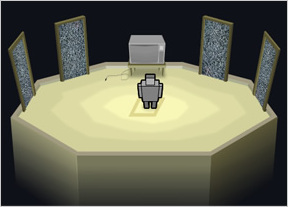 The original Gateway game was one of my favorites from the first CasualGameplay Design Competition (and one of yours too), so I was extremely excited to see that Anders Gustafsson had given us another chapter (hopefully in a series?) to work our way through. In case you missed it, Gateway II is also our runner-up in this competition.
(I will be careful in discussing the game here in case some of you haven't yet played through it. I don't want to spoil the fun of discovery.)
 In Gateway II, you again guide a robot, through a dream-like setting, in order to solve numerous and varied mini-puzzles for a seemingly unknown purpose (though a purpose there is, as you soon discover). Using well-placed musical cues and subtle environmental sound the author has created a virtual world that draws you in from the moment you launch the game. The setting and aesthetics are so enticing and mysterious, it doesn't matter at first that you don't know what your ultimate goal is (or indeed if you have one).
There is a tutorial available at the start of the game, but you probably won't need it even if you never played the first Gateway (and thank you Anders for allowing us to skip it up front this time!). Just click around to move. If something is highlighted when you mouse over it you can interact with it or pick it up, and you can drag objects from your inventory onto other objects in the environment in order to use them together.
None of the puzzles are terribly hard, though several of them are extremely clever and require you to actually think in simpler or more basic terms than you're used to thinking when you try to solve puzzles. There aren't really any puzzles in here that require lateral thinking or thinking outside of the box, but that in itself is pretty devious of Anders considering the audience.
Analysis: Neither the gameplay nor the approach are novel ideas in puzzle gaming, but there's something about the world that Anders has created that advances this game above other point-and-click style adventures. He has written an interesting and emotional story that surpasses the original Gateway (did it even have a story?), and incorporates the "Grow" theme of the competition in a surprising and unconventional way. The exemplary sound and music combined with the minimalist graphics establish a dark and sinister world for you to explore.
Anders took some hits in the comments and in the judging on the first Gateway for lacking accessibility features (we do score based on that), and this time around he has rectified that very well. Notice on the options screen that you can turn on captions for audio-based puzzles and gray-scale for color-based puzzles.
I did have one or two minor quibbles with the game. Pathfinding for the game is still sometimes frustrating, especially when going up or down stairs. I also noticed that everyone in the comments was giving hints on how to pass a certain puzzle involving a fire alarm and a rainbow, but when I first played the game I found I didn't actually need to trip that alarm in order to pass through the room and back again. While playing it again for the review the far door was closed and I had to go through the entire puzzle.
I also have some minor opinions to offer in the discussion of "The _______ Scene," but again out of courtesy to those who haven't yet played the game I will save that discussion (and indeed the nature of the scene itself) for the comments.
 From my personal review of the original Gateway: "I am guessing that the author did not design the 3D setup and movement system just for this contest, but instead created a set of puzzles using a previously made environment."
The sequel, if not the original, was certainly made using this route. I noticed that the difficulty of maneuvering through narrow areas was not fixed in Gateway II. However, it improves a lot on the original in terms of coherency and adherence to the theme of the competition. The story was intriguing and I liked how there was a feeling of being in Laura's subconscious, although I disagreed with the order in which the scenes purportedly took place. The puzzles, although often clever, were again slightly too simple. Overall, though, a fun and high-quality casual game.
 With Gateway II, Anders proves beyond the shadow of a doubt that he understands how to evoke emotion within the player of his games. He accomplishes it well in the first Gateway game, though it is for a brief moment in an otherwise plotless adventure. In the second, however, he accomplishes much more by weaving an engaging and emotional narrative throughout the adventure that unfolds as the player progresses.
Although Gateway II looks and acts like a sequel, it is more a second iteration of a game submitted to our first competition. Anders listened to the constructive criticisms leveled on his first Gateway creation, and delivered a more complete, more accessible game this time around. The result is an exceptional game play experience, and well deserving of the runner-up prize for the competition.





Walkthrough Guide
(Please allow page to fully load for spoiler tags to be functional.)
Complete Walkthrough
First Video Tape
Go left; press the button to open the door and get in the bathroom.
Get the hand mirror.
Examine the sink, open the warm water tap
Note the code on the mirror (7997)
Close the water tap
Enter the code with the keypad and get the first video tape
Go outside and follow the robot. Go back, stay under the light and use the mirror to blind the blinking eye above the door.
Get out, Insert the video tape, push transfer button twice, and watch sequences #1 and #2 (press play).
Press eject button to discard the empty tape.
Second Video Tape
Go right;floor sequence(numbers are tiles in order) 1,2,1,3,1,4,1,5,1,6,1,6
Get the lighter and the newspaper on the coffee table.
Open the top drawer of the dresser and get a screwdriver.
Note the three numbers on the painting (786)
Put the newspaper under the door and use the screwdriver in the lock: the key falls out on the other side. Get the newspaper back and get the key
Use the key to open the door.
Go to the far right side of the game window and get the tape.
Go back; solve the bridge puzzle again (first one backwards)to open the left door.
Get out, insert the second video tape, push transfer button twice, and watch sequences #3 and #4 (press play). Press eject button to discard the empty tape.
Third Video Tape
Enter the door right to the TV.
Turn the lamp on and off three times and wait for the return.
Use the pen to scribble on the note pad: a phone number will appear. Put down the pen.
Pick up the receiver. Dial the phone number. The right door is now open. Go right.
Use your lighter to set off the sprinkler and open the door.
Get the third video tape on the countertop. When the eyes appear, open the fridge door and hide behind the fridge.
Wait until the eyes leave and the door opens. Get out. Stay below the light and use your mirror to make a prism in the water.
This is the code for the alarm (Blue, Purple, Yellow, Green, Red, and Orange)
Set the alarm with the proper colors sequence to open the door.
Go back to the first room, insert the third video tape, push transfer button twice, and watch sequences #5 and #6 (press play). Press eject button to discard the empty tape.
Fourth Video Tape
Enter the door left to the TV.
Look through the window.
Force the student to create the following sums: ??+??=24, ??+??=79, ??+??=163
Go left.
Use the telescope to see the robot.
Turn the lamp on and off three times.
Use the telescope again.
Answer the phone and dial 11223311 (look at the note-like on the note pad). Go left.
Turn on the TV. Enter the code from the painting (786).
Get the fourth video tape in the wall. Go back to the first room.
End
Talk to the robot. It will collapse. Go to the TV.
Insert the fourth video tape, push transfer button, and watch sequences #7, #8 and #9 (press play). Press eject button to discard the empty tape.
Get the wire on the ground.
Back to the robot (it's a she): examine her and plug the wire in the hole.
Enter the tapes numbers in the proper sequence (264379851).
The robot stands up. Follow her and… the game is over!
Posted by: Mysteryman | April 21, 2007 4:04 PM